A couple of weeks ago I spent a full, entire week only going to my studio to work on my own work. I realised that this was the first time in my entire career that I had done this. I am 37. It is both a strange and not strange thing for a ‘professional’ artist like myself to say. Why have I never been able to do this before?
I think the TLDR here is everyone’s least favourite boogeyman: capitalism! I have to pay bills, and earn income to able to live and have the life that I want. At this point people might feel inclined to jump in and ask me why I’m not making enough money from my art practice to support myself… well, I don’t make enough of a stream of saleable work, and I am not of a level where I have gallery representation or enough of a profile to do so. Some years ago I went down the ‘productifying’ route for my work, and yeah, it was good for a time, but ultimately I made work I resented and didn’t feel like I was challenging myself beyond a need to churn things out because I was worried I would have a bare looking stall at events, or too many empty slots on my online shop. Some people find their niche of making their work saleable, well made, and authentic to them, but I didn’t. It’s a mode of supporting yourself, but I didn’t manage, or have the drive (?) to keep that going- so boo hoo back to the drawing board.
Like many artists I also teach but I don’t make regular enough hours for that to my the sole source of income for me, so inevitably I have a patchwork of freelance and zero hours contracts to keep things together (when it works). Like many, I also had a PT job during my time at art school, so didn’t even dedicate all my energies to my study back then. I sometimes wonder what would have happened if I had applied myself fully? I also find it funny that that is where my mind immediately goes- it must be some failing on my part- lack of motivation, dedication, talent, skill, when there are bigger, overarching influences that are out of my control. But equally between the ages of 18 and 22 you have a competing range of priorities that shape-shift continuously. We are preoccupied with establishing a new identity, socialising, building relationships… enjoying youth, as we should.
In amongst all this are things that are of my making and not. I chose to undertake an academic masters degree after graduating from art school, at a time when I was getting more opportunities as an artist. So I effectively pulled the plug on my own trajectory to do something I wanted to do, and felt would ultimately enhance my practice. But looking back I see that I ‘dropped the ball’ there, fell off the map and just well… fell off. With age I think, I’m glad I did that then because I couldn’t afford to do that now, and I had some great experiences and made friendships I wouldn’t trade for anything. But when I am reviewing my progress, or lack there of, I sometimes am tempted to file this under ‘master (lol) of my own destruction’.
I stopped making art properly between 2011 and 2013, and didn’t come back to producing work I felt was ‘me’ until 2016. I have written a lot about my use of collage as a way of finding my feet again, and I value that time, but I knew I couldn’t make that kind of work forever. I was always fighting in my own head with myself about going back to photographic work. It was scary because it was hard and I had nowhere to hide.
It’s a long and meandering road, being an artist, or just a human generally, and I look back and see a varied and strange path to where I am now. I couldn’t help but wonder if my art practice would have met even my own expectations if I had had more time to dedicate to it, or even more energy. For a while I tried to come to the studio in the morning and be *productive* before doing manual work in the afternoon and boy, did that not just really add to the sense of- wow this is not workinggggg.
I recognise more than ever that I need fairly specific conditions for my brain and body in order to be able to make the most of my time in the studio:
Not feeling rushed (rushing there- bad, having to rush away- also bad)
No overhanging obligation (a meeting, a deadline, anything I need to consciously remember)
Nervous system feeling REGULATED.
I am pretty sure any artist reading this will be like, gurl that is not happening ever, and don’t I know it. We are always making do, cramming in, contorting our brains and bodies around obligations and demands and everything else, and if you manage to squeeze out a small piece of work, or focus your mind for a short time- that is golden. I need to check myself as well remembering that there are many, many frustrated artists who are denied any opportunity to work, because of life circumstances beyond their control. I have a studio I can come to. I have materials. I have goals in mind. This is very much a me problem but many artists will face it to different degrees- how do you survive? How do you keep making work? Does it matter? Should you keep going?
I sometimes think about what would happen if I just gave it all up, like I have tried, that’s enough now. I guess it depends what I was expecting my life to look like. I have painted (sorry) myself into a corner with my skillset and experience and can’t really imagine what kind of ‘regular’ job would suit me, which is why I frequently undertake manual work. On the face of it I have made myself fantastically unemployable to the general labour market. I could start thinking about ‘transferable skills’ but I want to make it through the day… or maybe rEtRaIn In CyBeR.
When I have thought about writing about this previously I just feel like, it’s whiny etc, no one cares about your self made problem. But I also think it points to bigger problems that we all face, that of the role of work and ceaseless productivity drive inherent in much of modern Western life, the cost of living, and how we find and make meaning in our lives. I chose to live like this and I bear the consequences of my choices, but you can’t blame a girl for trying.
I think the real root of the problem is my own level of expectation for myself and my practice, the vision I hold somewhere in my head, which gets vaguer over time, of what ‘success’ would look like for me. I often need to zoom out. Sometimes what keeps me going is the idea that art, and art making, have value, and enhance our lives and experience of the world. That maybe my art speaks to someone and they feel seen and understood, intrigued or provoked, in the way that artworks have infiltrated my own consciousness.
Ultimately I feel like there is something about giving up that feels larger than just a shift in occupation for me. I am not planning on doing so in the immediate future but I am unsure when I will next have the opportunity to spend an entire week in my studio.
I figured it might be a good way to round off the year with a post, and although I haven’t quite established a regular posting schedule, I figure it’s better to write when you feel moved to do so, rather than forcing a post of dross out to tick a box on my to-do list.
Current reading etc
I am currently listening to the audiobook version of ‘The Body Keeps the Score’ by Bessel A. van der Kolk. A much recommended book, it has been a difficult listen in places (as any book about trauma is going to be) but has been eye-opening in many ways to the deep connection between body and mind. I think it’s very easy, as a cerebral person, to forget this, and this has been an invaluable digression.
I have just finished the latest issue of Spike Magazine- Vulnerability. Any magazine that has Tea Hacic-Vlahovic as a regular contributor is a must on my list.
I have completed my large scale commission I seem to have been endlessly toiling with (no pictures of the final piece until I’m over the initial hatred stage).
wip shot of the long commission. long in many ways…
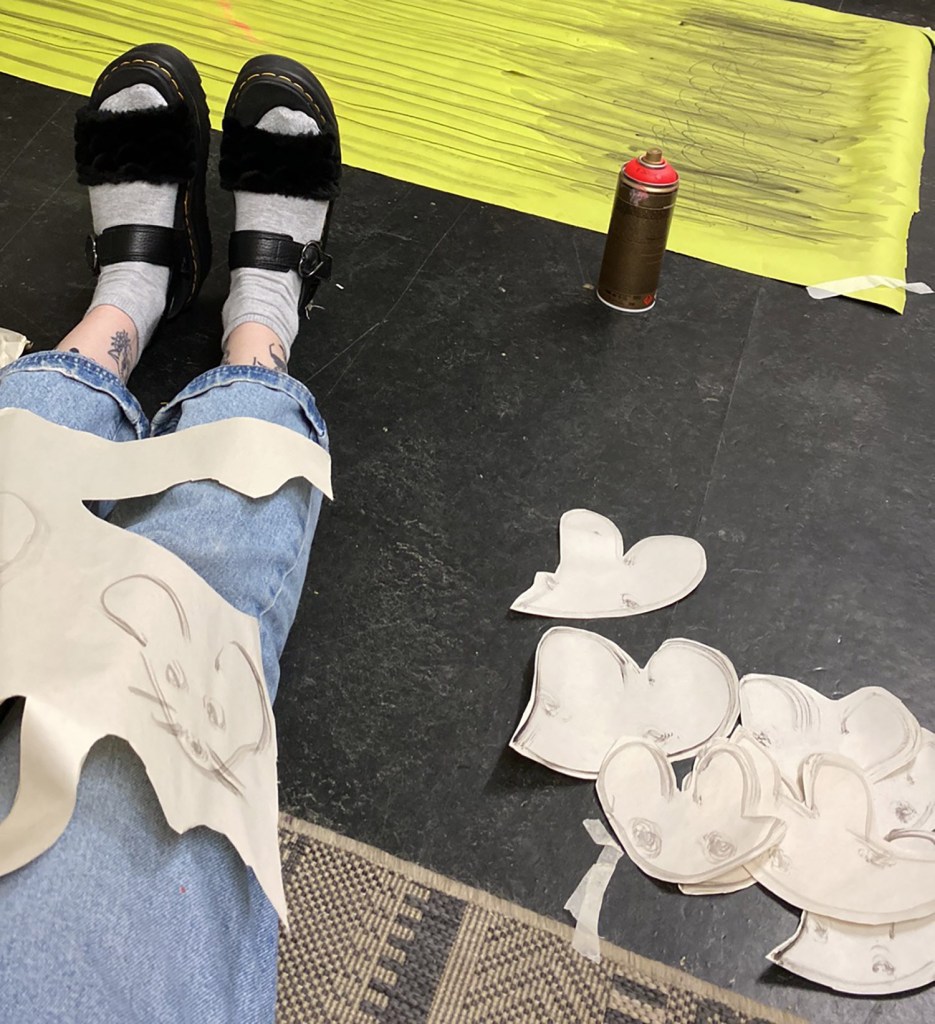
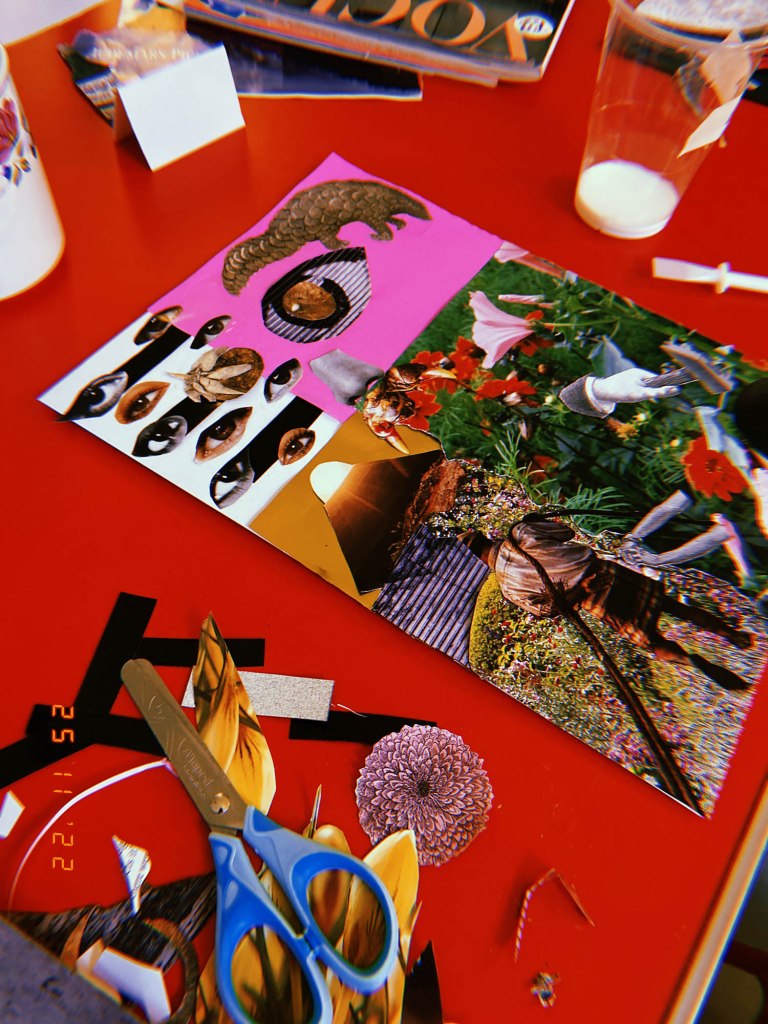
I have started another large scale mouse based collage work in my studio.
me making something awful
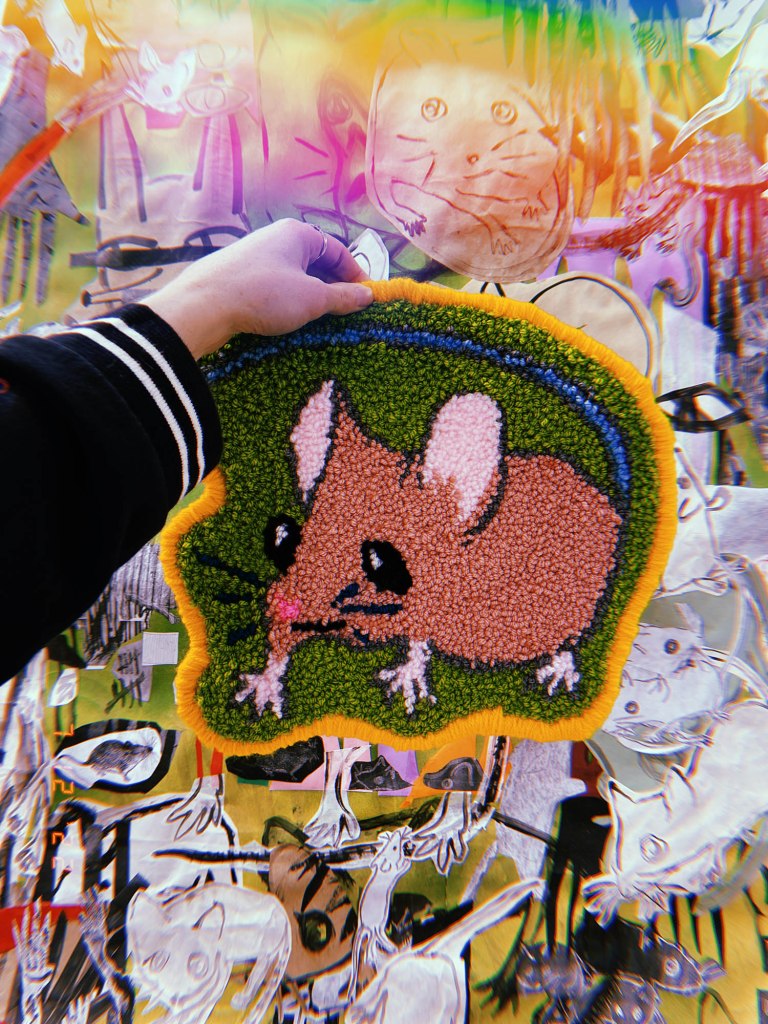
I made a few hilarious Cannibal Cubs tufted rugs as gifts for people (I wasn’t going to include pictures in case someone happens to read this, though I think I am safe to say none of my immediate circle would subject themselves to reading my blog as they are regularly exposed to the live show). As many people I’m sure are experiencing, life seems to be very expensive just now, and Xmas appearing in view is not a welcome sight when the budget is already zero. I have made more handmade gifts this year than I usually do- I am normally too busy making items for markets and the like, but having swerved that this year I found myself with a teency bit more time. There’s also something therapeutic about this particular process for my addled brain.
A mouse rugly made by me as a cyute gift. Normally my mouse rugs are a bit… intense? But I made this once nice and friendly.
Anyway, back to my version of the dreaded holiday newsletter. No one graduated, it was mostly toil. I jest.
2022 the year of leaving the ‘Kekun’.
2022 has been a year where with the rolling back of covid restrictions, I have been able to broaden the scope of what I was able to achieve in the public sphere, including exhibitions, workshops, and spending more time with people face-to-face. I think this was a necessary thing before I completely atrophied from lack of professional external contact and ‘putting myself out there’. I have a propensity to be insular when I am creating new works, but if I let that mentality seep across my entire professional life I am at risk of disconnecting in a way that isn’t healthy. Being a loner works for some artists, and I think everyone needs this to a degree, but at this stage in my life I can’t really become a total recluse. Yet.
As I’ve detailed before, the covid years provided me with time to develop long neglected sides of my practice such as beginning to draw again, picking up my analogue camera more regularly, and starting to produce written works. But we humans are social creatures and although I was able to glean some small benefits during an overwhelmingly stressful and dark time, I am glad to have been able to re-emerge and ‘do the things’.
As a practitioner this year has been invaluable in taking my first steps back into teaching. Covid restrictions made workshops retreat to the online sphere, and it’s been nice to actually get out and connect with people doing creative activities again. It was a confidence boost to remind myself of my own capabilities and also the enjoyment that art can bring to people’s lives, with simple materials a lot of the time. I am hoping to build on the workshops I have provided so far, as well as expanding my freelance working to include some more consistent teaching and facilitation. Upswing!
Image from a recent collage workshop held at a local community warm space.
Existing in the current economic climate has arguably been a challenge but this is not unusual for artists or those working in the ‘creative industries’ (am I the only one who hates that term?). Many of us are all too familiar with instability, precarity and the need for fortitude and adaptability. Saying that however there is only so far that a positive attitude can take you (maybe I’m not *manifesting* hard enough), and when bills just need paid you start to question whether you have chosen a foolish path. I think questioning your choices is pretty much innate in ‘art life’, but it has had an acute, sharper feeling this year. I have always pursued other employment whilst being an artist, but have had periods this year where I had no additional income and it was at times, destabilising. I have once again sought alternative, part time flexible employment, which will take the pressure off- even if the logistics are making it harder to commence than anticipated. I am resourceful. I will survive. I will ride my sewer crocodile into the sunset. Soon.
everything is trash and I am falling over.
But sometimes it does not stave off the creeping sense of discomfort that choosing this life was a mistake. I am sure that most creative professionals encounter this sensation, probably daily in some cases, but many of us seem to manage to keep on, keepin on, and strive towards having the sorts of lives they want to live. Also maybe we don’t talk about this enough? Only amongst close confidantes? Should artists talk more about ways to survive together? Do they already have support groups I am not invited to? Something to ruminate over next time I’m trying to meditate. Intrusive thoughts!
Anyhoo.
What keeps me going? What keeps me going in the dark night of art soul?
this again.
ART FRIENDS!
Mostly peer support. Having other people around trying to live the same kind of lives makes you feel like you are not alone, and that you are not in pursuit of the ridiculous (even when you probably are). Mostly. It gives you a sense of community amid an existence that can feel like chaos, or just out and out permaslog. Feeling seen and heard is important, having people to turn to for advice, or just to complain to can, like all problems, make the load a little lighter, even just for a while. I am forever indebted to my studio mates and other creative friends for this. But I wasn’t always so lucky. It took me a long time to build networks, and I had to actively seek out opportunities to meet other artists or makers. I initially did this by applying for selling events and naturally seeing the same faces, as well as attending a course entitled ‘Sustaining Life as a Creative’ in 2016. I was able to meet a whole room of people trying to exist as a creative in differing ways, and made some lasting connections as a result. We soon realised we all had versions of the same problems, and it made me feel less isolated. It took me a long time to actually not be isolated however, but this was the beginning of that process. I was lucky to stumble across this course, but depending on where you live you might not have these opportunities so readily to hand, and have to rely more on the interwebs to connect with others. I have dabbled in this also, but I’m actually kind of rubbish at consistently being on instagram or other platforms, so my lacklustre presence doesn’t inspire a constellation of pals and potential. It’s hard to invest a lot of time and energy in being ‘online’ all the time, I find it quite intrusive into my regular brain space. There are certainly lots of people who excel at this- more power to them- but I need IRL support or I crumble.
What else helps?
BEING A NERD!
Reading the biographies of other artists is usually a good morale boost, and has always provided me with much solace. Understanding that the path is not linear for creative people can give a sense of hope and comfort when you wonder if you should have just… done literally anything else. The only thing that can mar this slightly are biographies that include scenes of extreme wealth and status that make you think… okaaaaay, I’m not the offspring of an aristocratic dynasty or the great nephew of whoever… but there are always *some* commonalities regardless. Creative struggle is struggle, but some people have more of the general life struggle than others. You’ll never find a complete mirror of your own experience in such accounts, but a glimmer of recognition is still something in the dark.
MORE READING!
approx 1000000 books belonging to me
I have also read many, many advice books for artists, and will list below the ones I have found the most useful. I also try to read relevant blogs, like The White Pube, which features helpful advice columns, and find solace and a dark chuckle in niche meme accounts for artistic life.
Useful books/Books I have read:
‘Ways of Being: Advice for Artists by Artists’ by James Cahill– predictably this had some gems and some so-so nuggets of wisdom, as marmite as the artists themselves will be for many people. Highlights again the differing journeys each artist will have, and that success takes many forms and has varying timelines.
Plan & Play, Play & Plan: Defining your art practice by Janwillen Schrofer– this was helpful when I was trying to become more comfortable with the rhythm of my own practice, the importance of play, what productivity actually can look like. It was dense and well put together- I need to revisit it.
How to be an Artist by Jerry Saltz– this was a high energy collection of pep and encouragement, acknowledging that not everyone’s practice will look the same but there is inherent value and importance in just showing up and trying. Art is hard work! Jerry wants you to get to it, stat.
I also liked this just because: What Artists Wear by Charlie Porter– fun dive into the sartorial lives of artists and what it reveals about their differing ways of existing in the world. It’s never ‘just clothes’. As Leonard Woolf said, ‘Nothing matters, and everything matters’.
This coming year I am trying to bring a greater sense of stability into my life, with more regular freelance work and sporadic part time employment (hahaha I am aware how that sounds… ha). It’s hard to create and be creative sometimes when you are constantly thinking about the rising cost of everything (particularly materials, sweet baby J), so I am hoping that my employment changes will engender a slightly greater sense of security that might free up my creative brain. Fingers crossed.
I am still pleased with the variety of projects and shows I have undertaken this year, and similarly hope to build on this again next year. I think it’s easy to underplay your own achievements but in the midst of what has at times felt like a difficult year, I have still managed to pull together work and explore new avenues, new techniques, all whilst moving studio (goodbye OG Kekun Studio, hello Arkade Studios) and working on larger projects.
Also committing to maintaining and creating this blog has been a step I had wanted to take for a while, and although this is only in the very early stages of becoming something, or indeed anything, I am pleased I took the step to encourage me to write more, and share my thoughts and ideas with a wider community.
Thanks for reading- I hope you have a restful xmas/holiday break
I have been working as an artist for many years, but only in the last few have I taken on a permanent rented premises in which to make my work.
Post art school, or in the early stages of building a practice, this is a dilemma many artists face- where will I make the work I want to make? Do I need a studio? Am I legit if I don’t?
(Disclaimer: I’m using my art school —-> real life journey as an example here, but there are obviously many, many ways to start and maintain an art practice, and the road this takes towards needing a studio or not. Leaving art school can be quite a shock in some ways as you go from having lots of space and facilities to (often) nothing. It’s like being a very spoiled pet and suddenly you’re an alley cat. Other routes can involve this harshness from the get-go, so I appreciate the years I had before the Big Bad World encroached).
To rent or not to rent
For some people their practice necessitates the sourcing and renting of a studio by virtue of the method or the scale of the work produced. But many of us who use a laptop, or a desk, to work (though limiting oneself is also dangerous…) it can seem like an unnecessary expense to rent somewhere to make artwork.
When I was a fresh graduate I took a space with a couple of other artists in an open-plan, office style, pig-pen set up. I really didn’t use the space as often as I should have, due to waning motivation after the initial post-graduation rush, and the cramped nature of sharing with several others. I had to give up the space fairly swiftly, as an unused studio quickly becomes a financial burden, and the guilt is just as anxiety inducing (are you even an artist??? what are you doing???). I think I had yet to work out exactly what I wanted from a studio, and what kind of space I actually needed for my practice- too much too soon.
Following this, for most of the years after I graduated I worked from home, at a kitchen table, a living room floor, or wherever the work suited. Because my practice was largely photographic or paper based I was only really in need of a desk. I missed darkroom access once I left art school, and made various attempts to construct my own darkroom- one memorably in a basement where people also… hung their washing… anyway- the least said about that the better as the photos that emerged were as dire a quality as the overall experience. One star, would not repeat.
When I shifted towards more academic study and stopped making work as regularly I didn’t really worry about having a specific place to work as it would be whenever the whim to work took me, and subsequently I spent many sporadic collage years accidentally gluing hair from the bedroom carpet into whatever I was making.
Making of meaning/meaning of making
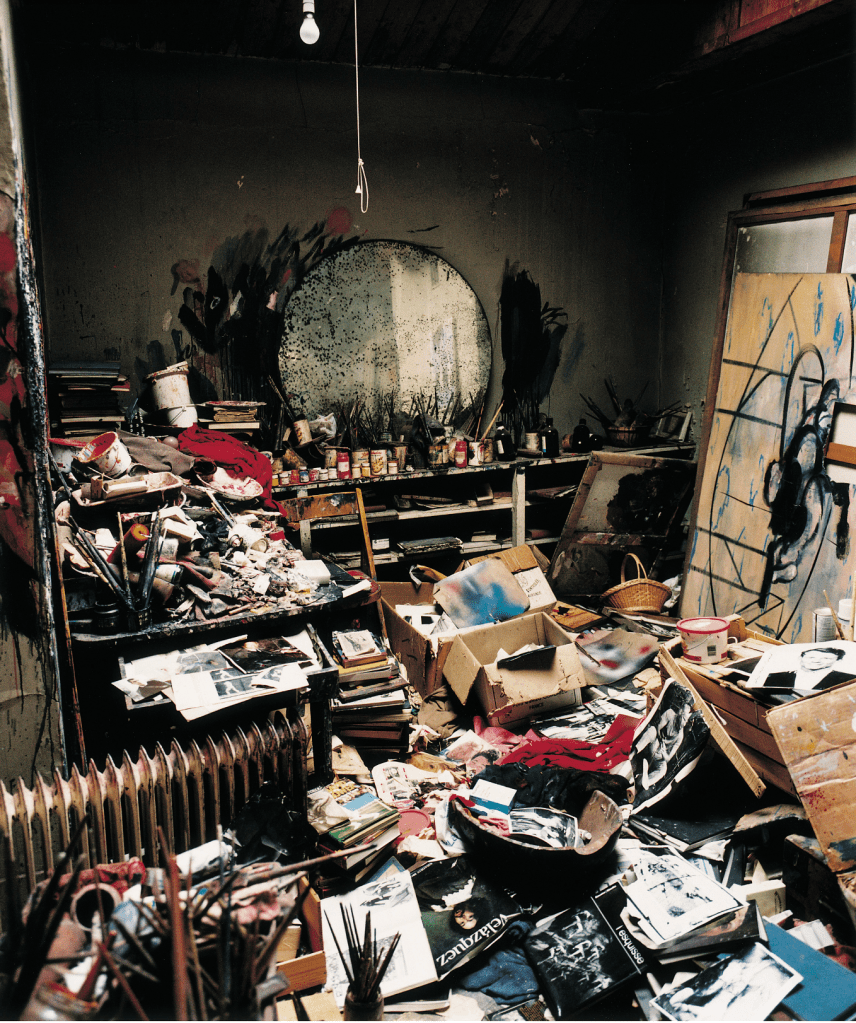
Francis Bacon’s studio. sorry.
I always thought a studio (in some part of my lizard brain) was something you had when you had ‘made it’. My definition of ‘making it’ at this point would have been successfully making and selling work to the point where you are self-supporting and need a place to produce the steady stream of perfect pieces people are banging on your door to buy.
So in my mind a studio became a sort of legitimising thing. A validation of artist-ness. It was something that came along with the ability of being able to say ‘I’m an artist‘ without looking around shiftily or sweating. I used to feel kind of embarrassed when people asked me if I had a studio and I said I worked from home. Perhaps because I was reading some kind of glee in their response that I wasn’t a real artist. I think these days that’s known as projecting, but that’s not to say that you don’t encounter lots of people along your creative journey who would like to see you fail. That’s life innit. Haters gonna… delegitimise-your-shaky-sense-of-self-perpetually-unless-you-harden-yourself-and-nurture-self-belief. Anyway.
Home working before it was mandatory
I quite liked working from home in a lot of respects- it’s cheap, it’s easy to work any time, you can take breaks without judgement (inner critic aside) and have some element of privacy (where possible). But it can also be hard to delineate your time correctly between work and leisure and self-motivation is a major element (I mean arguably it’s core in any artistic practice, but it takes a lot of willpower not to just sit on the sofa).
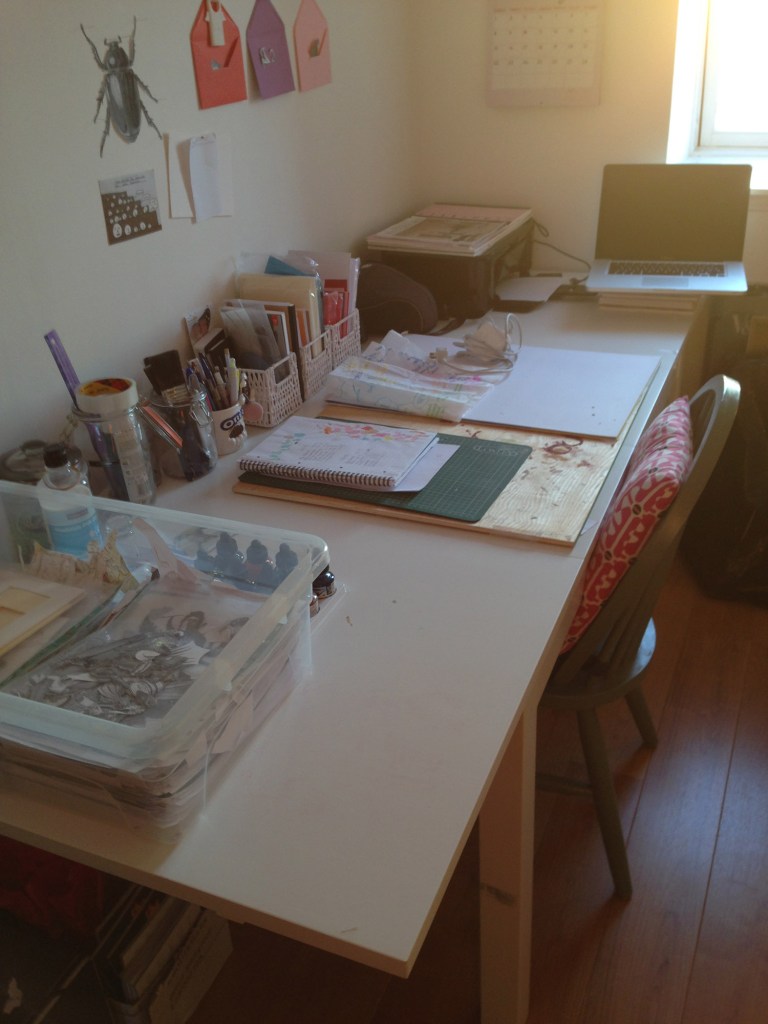
Very early working from home set up. Wow so neat.
My peak of home working probably occurred when I was working several jobs, some art, some non-art related, whilst kickstarting my practice again, between 2013-2016. I often needed to make work for shows, events, markets etc, and had to work predominantly in the evening or at weekends. I found this quite an exhausting time. It was great to drive my practice forward at pace and have actual deadlines to push towards, but man, I remember a lot of going straight from my desk to bed in a fugue state.
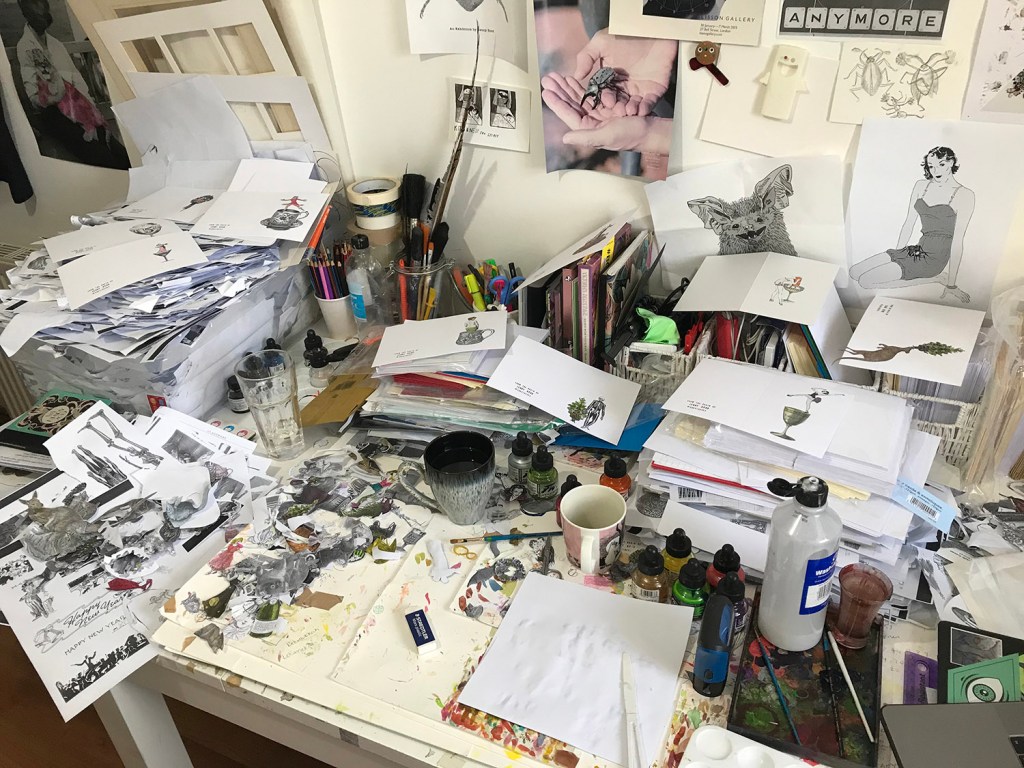
My desk when prepping for a selling event, circa 2015/2016. Did I mention how much I hate making greetings cards?
When I first started having a ‘studio day’ I found it really hard to structure my time. I think initially I was being far too rigid. I had this idea in my head of what my day should be, or look like, and I would either fritter away the time meeting up with someone (people would often call my studio day a ‘day off’ ha ha haaaa), or I would just panic that I wasn’t using this time wisely enough and freeze. There’s nothing more stifling for creativity sometimes than having a designated ‘art time’. Like cool, no pressure then. But often this is the reality of your schedule. Capitalism! It demands we work to survive, so we have to fit everything else in.
oh no not this.
Motivation and its discontents
There’s also this notion of ‘everyone has the same 24 hours’ which can be particularly toxic for creatives. I remember once reading an interview with some fashion entrepreneurs in a magazine for an online brand/retailer. They were both young, high flying and successful. One of the questions related to how they managed to build their brand alongside working other ‘normal’ jobs. I think the response was along the lines of ‘be like Oprah! Get up at 5am’. I remember feeling like… so if I don’t sword-dance with burnout constantly I’m not trying hard enough? And I shouldn’t have any time to rest? Which is integral to creativity, and errr, sanity? Infuriating. Damaging. Bullshit. I’m not saying that it doesn’t take lots of hard work to make anything a success, but when did this gross side-hustle-girl-boss-entrepreneur-influencer work ethic become the only way?
The long and the short of my particular version of this saga is that in order to dedicate more time to my practice I had to let go of some paid part time work. This has happened twice in my career so far, once with a part time job and once with some freelance roles. I just couldn’t handle having four separate jobs, and trying to work on my own projects at night when I felt like I couldn’t keep my head off the desk. Demoralising and unsustainable- delightful! My moods ranged from Eeyore to Godzilla and I hated everything I made. Awful. Again, one star, would not repeat.
I reduced my paid working hours enough to cover myself, and carved out extra time for my practice during the day. I was able to breathe and take the pressure off those bounded moments for creativity in my schedule. I still overcommitted myself to events and projects (saying no, not my forte), but I didn’t have to do all my working at night. It took me ages to relearn that evenings = downtime. I still struggle with this occasionally when at home, as I still have a work room which can beckon me. What is relaxation?????????
A different kind of ‘Kekun’
During 2019 I became involved with a local art collective/studio, Kekun Studio, that had a premises in an area of the city that wasn’t far from my home. I began spending time with the resident artists, Mary Butterworth and Jon Reid, and participated in two collaborative shows (Little Shop of Horrors and Bygone) and assisted with their residency programme. In early 2020 I was offered the chance to become a permanent part of the studio and rent a space there, alongside my collaborator on Cannibal Cubs.
Kekun studio, 2019
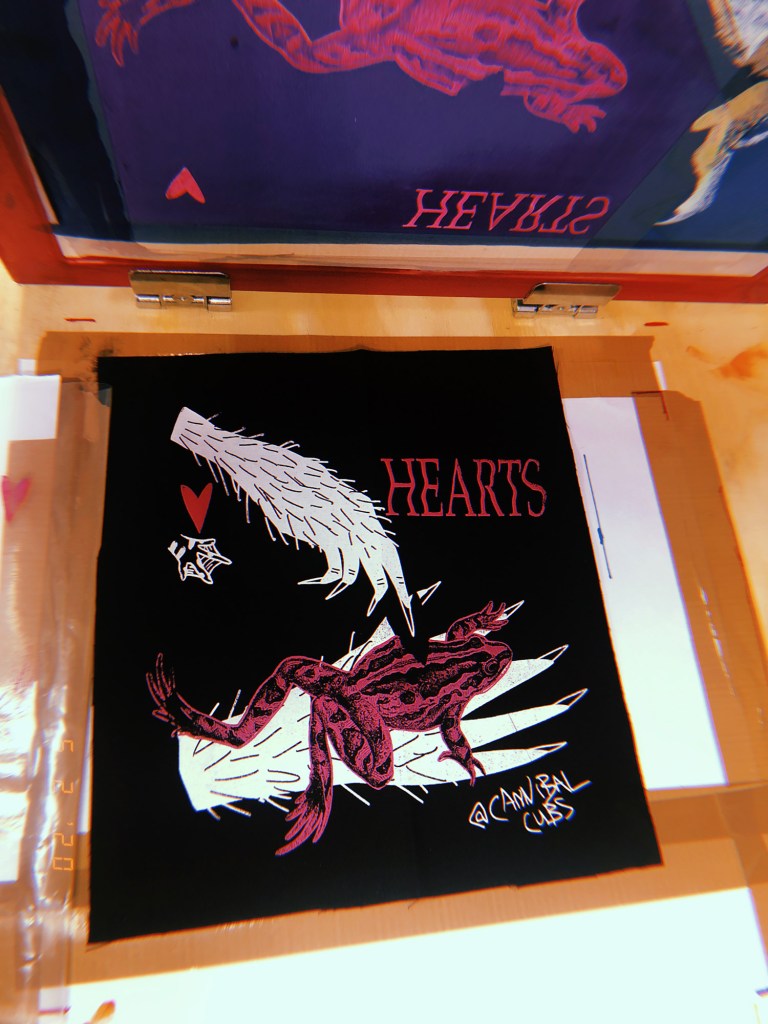
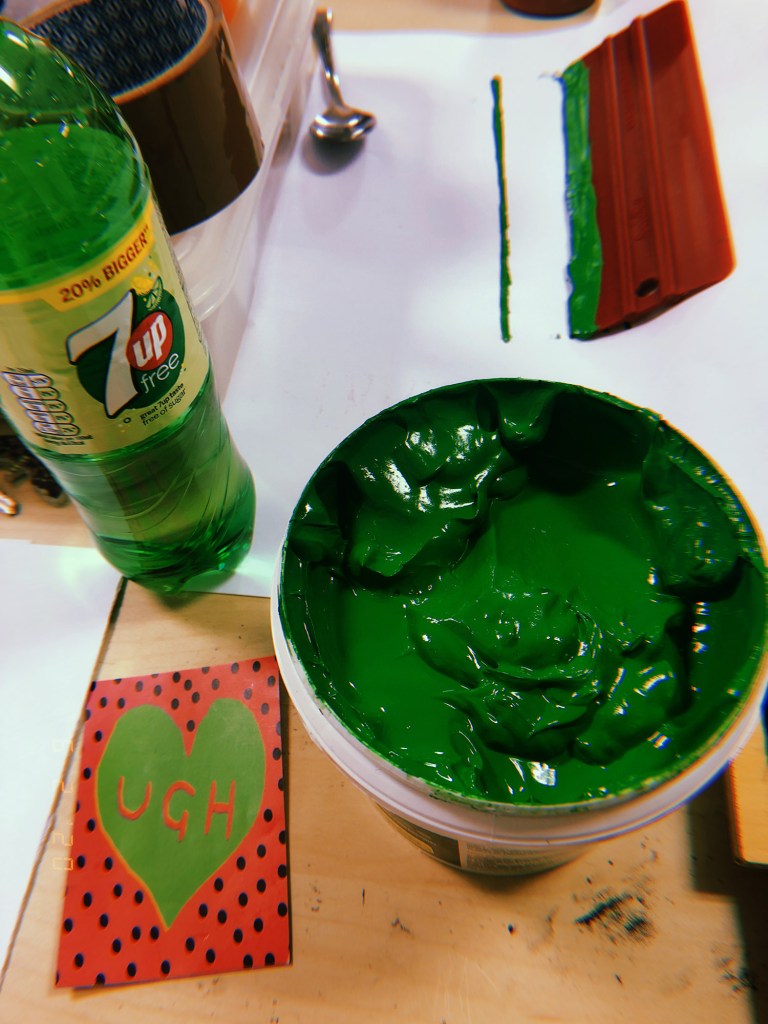
This was my first real experience of having a studio and it really opened up the range activities I could undertake. It was particularly useful for the Cannibal Cubs projects as we had a space we could screen print in more easily (having previously worked on a living room floor, cleaning screens in the shower).
Screen printing Cannibal Cubs products at Kekun studio, early 2020 (pre covid!).
It was also helpful to be around other artists again, an experience I had previously left behind in art school. It’s invaluable to have other people around to discuss elements of professional practice with, to shoot the shit with, complain to, rejoice with. It can make choosing a life like this less lonely and a unrelenting perma-slog (it’s fun really! Kinda). It can be hard sometimes for people with more linear career paths to grasp the precarity, unpredictability and sheer grind of working for yourself in the creative industries. It also allows you to become part of a larger network, hearing about opportunities, meeting fellow creatives, as well as learning new skills from the people around you. Professional practice and development is something a lot of artists struggle with, and I wouldn’t have gotten by without others sharing their advice and experiences with me. Beyond this, it also teaches you that there is no one ‘right’ way to be an artist, to make work, to exist in the world. I think I was very lucky to be in a studio situation where all the other residents were people I could count as friends.
2020 naturally presented some challenges with regards to being allowed to use the studio, but when restrictions slowly changed around working away from home, I was able to utilise the space again, and this was a welcome respite from always being in the same place. It provided a much needed element of work/life balance, as well as contact with people outside my ‘household/bubble’ (anyone else feel triggered by these words? If I never hear the word ‘household’ again I’ll be delighted). The studio became a lifeline for us during a strange, unsettling time, and prevented my practice from going into homeworking stasis.
The space provided by the studio allowed me to expand the scale of works I was producing, and in my last months in Kekun I was experimenting at a scale I had not previously tackled before- with painting, drawing and even constructing a textile based installation. Kekun, its occupants, and its facilities, were instrumental in broadening my thinking around my practice, as well as diversifying the methods and materials I was willing to challenge myself with.
An installation set up for a project I was working on in Kekun studio (2021)
New beginnings
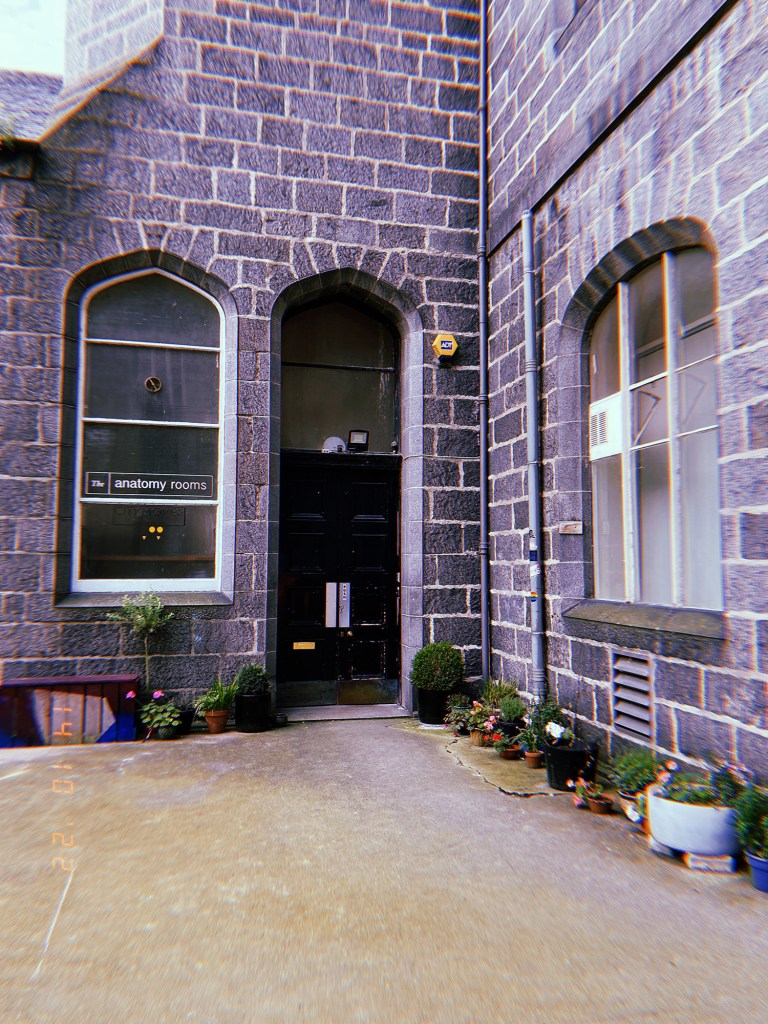
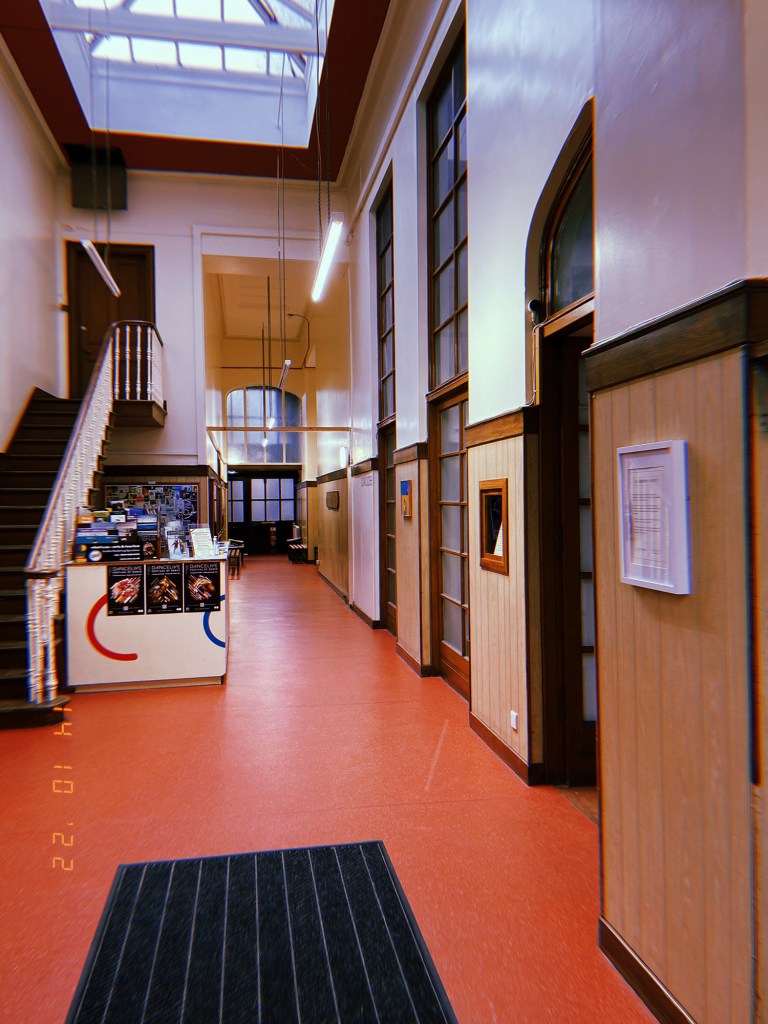
Unfortunately in the summer of 2022 we all had to vacate the space due to a rather strange situation with a neighbouring business. This was a big wrench, but the studio had become a difficult place to work, and the once welcoming, relaxed atmosphere had been damaged irreparably. We were all very lucky to find spaces in another large city-centre complex- The Anatomy Rooms, run by All In Ideas and home to Arkade Gallery and City Moves Dance Agency.
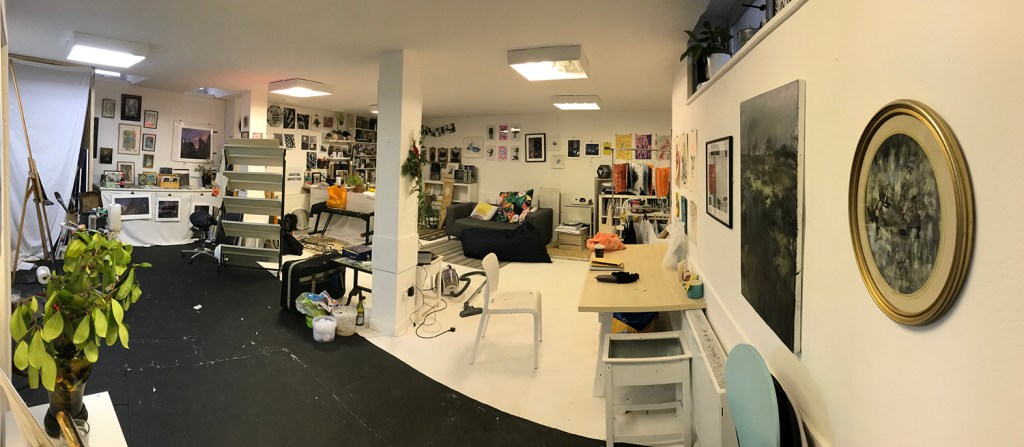
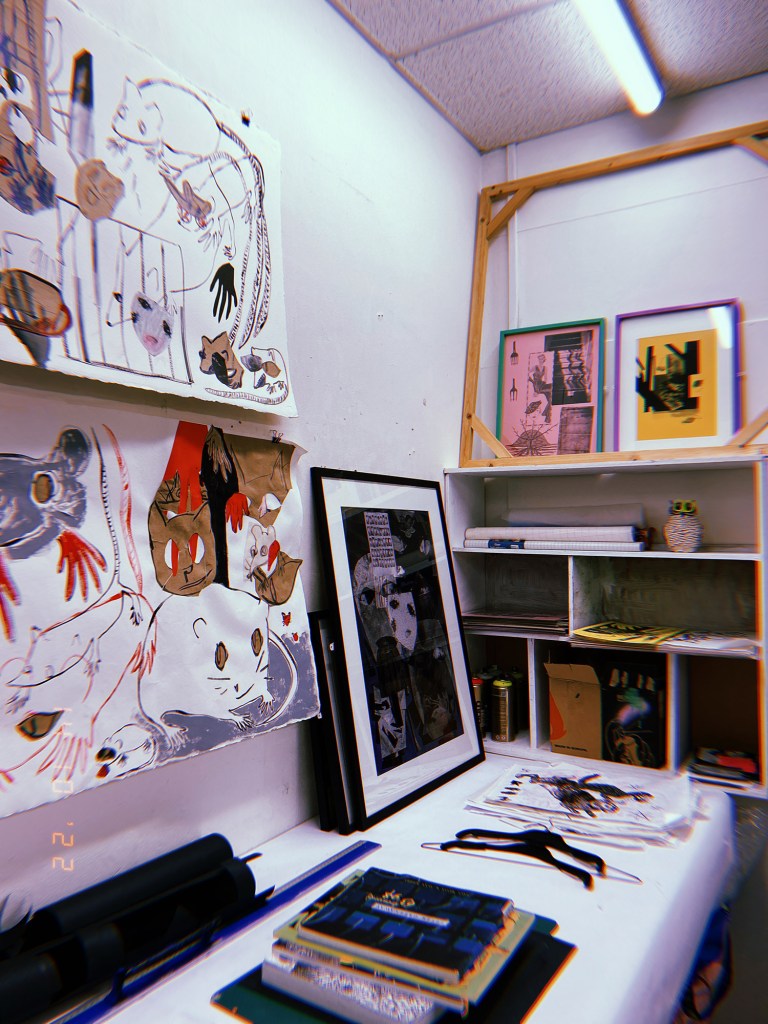
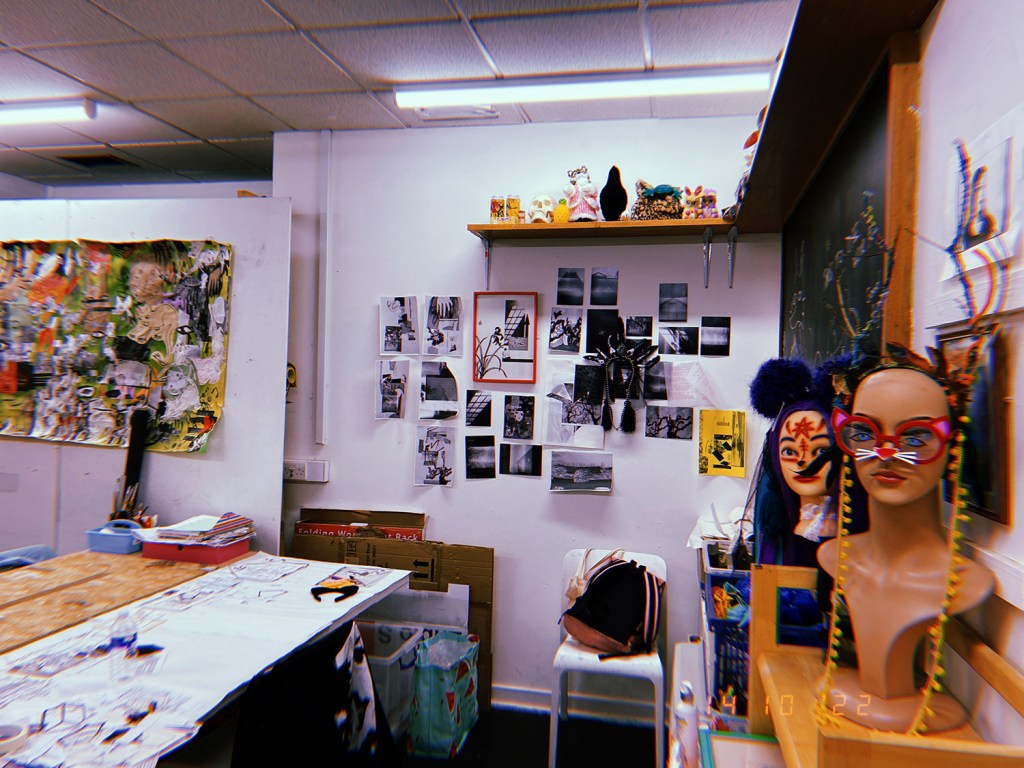
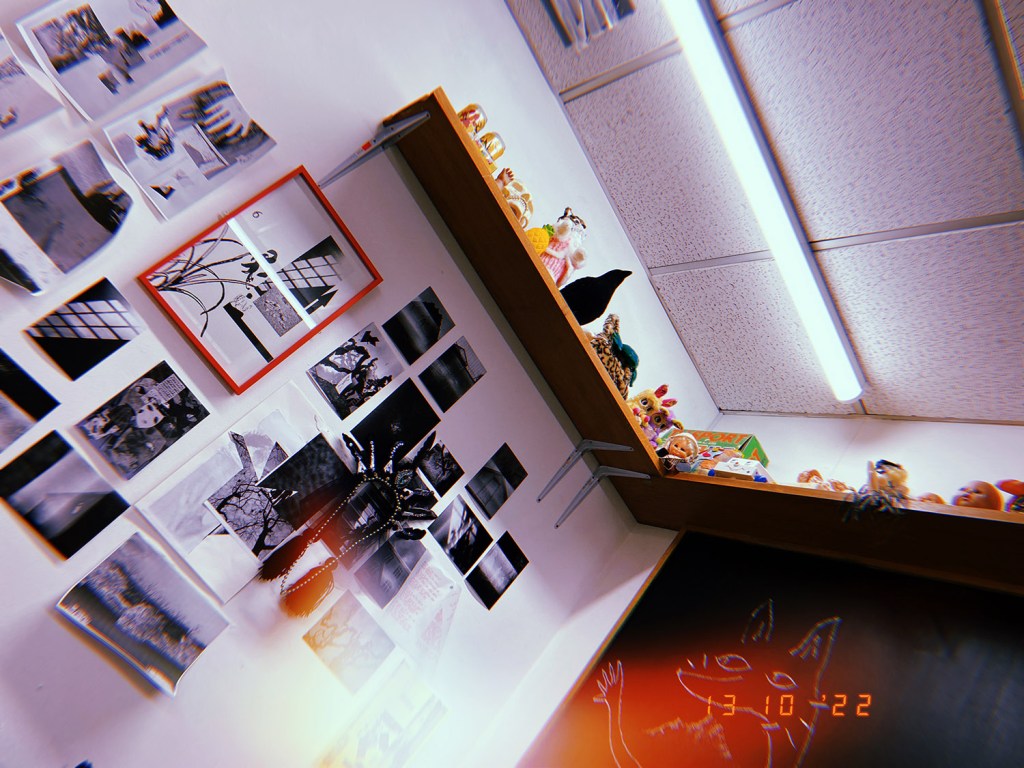
I moved into my new room there in early September 2022, and although the move was protracted and gruelling (oh the lugging), we are all ultimately happier in our new spaces here. I have my own self contained room, just along from where my old studio mates Jon and Mary also have their own spaces.
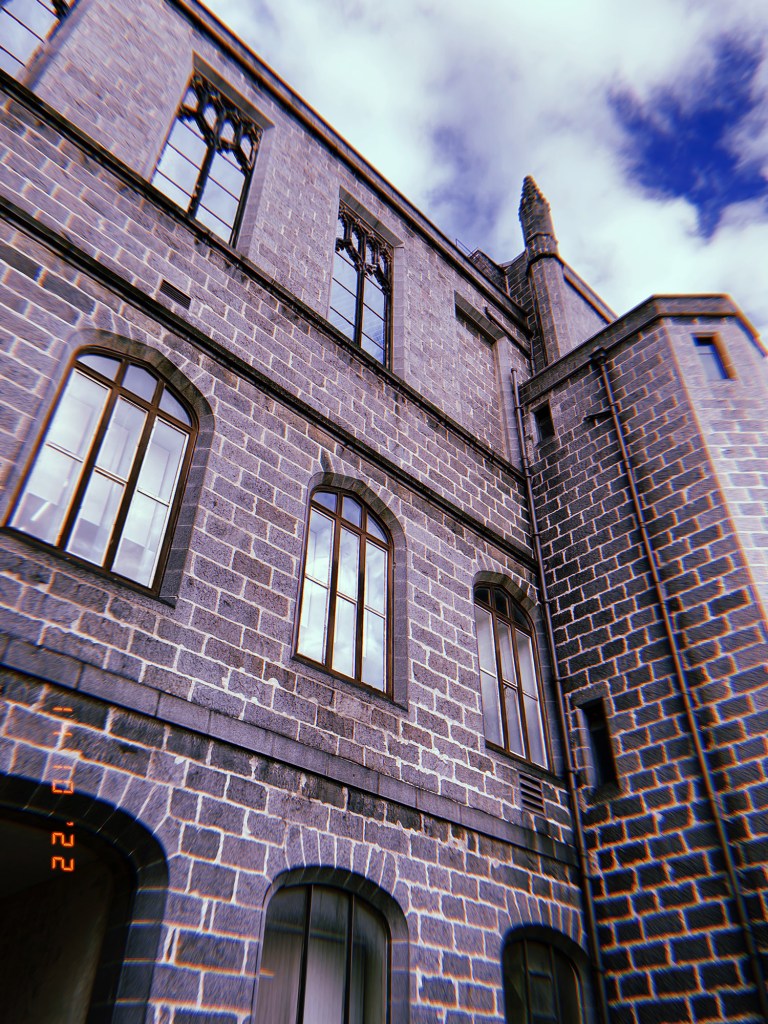
The Anatomy Rooms is a building that’s steeped in history (having been, as the name suggests, the anatomy building for Aberdeen University) with a lot of unusual features (disused morgue anyone?). It has been an artist studio complex for many years now, equipped with an exhibition space (Arkade Gallery), areas for teaching, and larger scale events. Being part of a studio like this means I am already embedded in an artistic community. It makes it easier for me to hear about, and be involved in, projects and events. Not that being part of a studio or an organisation should be a prerequisite for this, but I can sometimes be lax in keeping informed about what’s going on, or what opportunities might be open to me. My head is invariably in ‘making mode’ not ‘promote self and be successful’ mode *chefs kiss*. I also resent the tyranny of Meta apps to keep up to date with… anything.
I think it also depends on what phase of working I am in. Sometimes I am deep into a research/making phase, and I don’t want lots of outside stimulation, or I don’t have the bandwidth for anything participatory. But at other points in my ‘making cycle’ I am more open to involving myself. I recognise this about myself more as I develop as an artist- when I am most likely to make the best of a situation, or apply myself to the required standard. Sometimes, particularly after the completion of a big exhibition project, or body of work (even if it’s unseen…) I can feel really drained. I didn’t understand that post-project slumps are a thing, until I talked to other creatives and found there was a common theme of collapse after doing something big, or something that requires ‘giving your all’. It can be similar to burnout, but manifests in different people in different ways. For me I can feel like I want to lie in a dark room with absolutely no stimulation for maybe… four years? I jest. Maybe.
Anyway, I hope you have enjoyed, or at least managed to follow, my foray into my relationship with renting studios.
Last point- would I say having a studio is a good thing for an artist? I think it’s a good thing if it works for you. If it suits your practice, your temperament, your budget. I’m ultimately glad I gave it a go as for me it was beneficial to the development of my practice on a few levels. But I always know that if I had to go back to a spare room, a table, a floor, I would make it work. Adapt or die eh.






 DRAFT EXCLUDER